
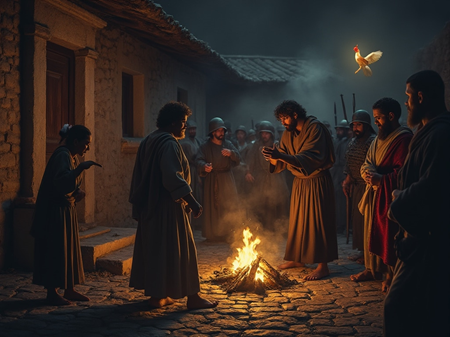
During the earthly ministry of Jesus, His disciples enjoyed the privilege of walking closely with Him. They witnessed His miracles, experienced His protection, and never lacked their daily needs. Many of them hoped that Jesus would soon establish His kingdom and grant them places of honor beside His throne. As mentioned previously, even the mother of James and John approached Jesus, requesting that her sons be granted seats at His right and left hand in glory.
Jesus responded with grace and gentleness, reminding her that such positions are determined by the Father in Heaven. His answer did not rebuke her motherly concern for her sons, young John and James, who followed Jesus faithfully each day. Her desire to care for them is something many nurturing mothers, including my own, can easily understand.
Yet the deeper issue is not about position, honor, or proximity to the throne. The true question is one of loyalty to Jesus, regardless of where one may sit. Today, many believers associate following Christ with prestige, protection, comfort, or immediate blessings. But discipleship does not operate on such terms. Genuine loyalty is tested, refined, and proven—often through trials.
History bears witness to countless Christians who remained faithful even unto death—whether by sword, fire, beheading, or being thrown to wild beasts. Their steadfastness revealed the depth of their devotion. Could we demonstrate the same faith if placed under such pressure?
Even the twelve disciples struggled. Judas Iscariot betrayed Jesus for thirty pieces of silver. After Jesus was arrested, the remaining disciples fled in fear. Peter, who boldly vowed to lay down his life for Christ, fulfilled the prophecy spoken to him: “You will deny Me three times before the rooster crows.” Within a short span, Peter denied knowing Jesus at all.
If such devoted followers faltered, we must humbly acknowledge that we, too, are capable of failing. It is easy to listen to sermons about serving God, doing good works, giving tithes, and living righteously. But when trials arise, when fear, pressure, or temptation confront us, will we stand firm? Or will we be the first to run, hide, or deny the truth, even through careless words or actions?
True loyalty to Christ is not proven in comfort, but in testing. It is not measured by what we receive, but by how we remain faithful when everything is shaken.
As we prepare to enter another year, it is fitting to reflect on the many festivals and holidays that Christians observe. We must ask an important question: Are these celebrations truly appointed by God? As mentioned earlier, December 25th is not a date established in Scripture for celebrating the birth of Jesus. In fact, the only observance Jesus explicitly commanded His disciples to keep is the Last Supper. Yet even this sacred remembrance is often neglected or treated lightly, despite Jesus’ clear instruction to “do this in remembrance of Me.”
Jesus said, “Do this in remembrance of Me,” referring to the breaking of bread and the drinking of wine. He explained, “This is My body” and “This is My blood.” The bread symbolizes His body given for us, and the wine represents His blood shed for the forgiveness of sins. This act of remembrance is the most significant observance for believers, for it directs our hearts to His sacrificial death on the cross, our only path to salvation.
Another sacred observance appointed by God in Scripture is the Year of Atonement. The Lord commanded His people to keep it each year—a holy time set apart for repentance, reflection, and spiritual renewal. In many ways, this divine rhythm mirrors the transition from one year to the next. Although New Year celebrations are widely practiced today, they are seldom approached with the spiritual depth God intended.
The turning of the year should be a moment to seek God’s forgiveness, to lay aside old patterns, and to dedicate ourselves anew to righteous living. True renewal of the heart is the essence of the New Year, and it echoes the very purpose of the Year of Atonement. As God instructed Moses: “This is to be a lasting ordinance for you: Atonement is to be made once a year for all the sins of the Israelites.” (Leviticus 16:34).
Some preachers teach that we are saved by grace, and I agree that salvation begins with God’s grace alone. I have heard this message many times in church. However, this does not mean that salvation is automatically guaranteed from beginning to end, regardless of how we live. I do not believe this is what Jesus intended. If salvation were permanently secured without any responsibility on our part, why would Jesus command us to pray continually, to repent daily, and to remain watchful? If “once saved, always saved” meant we could persist in cheating, greed, hatred, foul speech, or any form of sin without consequence, then the call to holiness would be meaningless.
Such thinking would reduce the sacrifice of Christ to a mere formality rather than a call to transformation. It would make His death appear as something to be taken lightly. Even more concerning, some who preach humility do not model it in their own lives or homes. Their outward appearance or behavior may contradict the very virtues they proclaim. This inconsistency serves as a reminder that true discipleship is not about outward display but inward obedience.
The deeper truth remains: Christ’s death does not automatically save every person. Jesus taught that we must pray continually and repent sincerely for the sins we commit. If someone refuses to seek forgiveness and physical death overtakes them in that unrepentant state, they face eternal separation from God. Repentance is not a one-time event but a continual posture of the heart. Salvation is offered freely to all, but it must be embraced through faith, obedience, and a life marked by ongoing repentance.