As John recorded these visions, they were given for our awareness and our benefit. His revelations are not to be taken lightly. I must emphasize again that they serve as warnings. Although some of the events he described have already unfolded throughout history, parts of these visions are still awaiting fulfillment and will occur in God’s appointed time.
This leads to a crucial question: when these things come to pass, are you truly ready? Jesus is asking you this.
This question brings to mind the moment during the Last Supper when Jesus, troubled in His spirit, said, “Truly, truly, I say to you, one of you will betray me.” Peter, unsettled and confused, asked, “Lord, where are you going?” Jesus told him that he could not follow yet, though he would follow later. Still, Peter insisted, “Lord, why can’t I follow you now? I will lay down my life for you.” Jesus responded, “Will you really lay down your life for me? Before the rooster crows, you will deny me three times.” (John 13:21).
Peter’s reaction reflects how easily any of us might respond under pressure. We may think we are strong, but when fear confronts us, that is, whether the threat of a sword or the sight of flames, we may be tempted to run, to deny our faith, or to abandon our devotion to Christ. And just as some reject Judas Iscariot, a person can become like him: someone who betrays fellow believers when the pressure rises. Much depends on the motives, desires, and priorities of the heart. If, like Judas, a person values money or worldly gain more than Jesus, the temptation to betray becomes far greater.
This is why Jesus warned, “Watch and pray so that you will not fall into temptation. The spirit is willing, but the flesh is weak.” (Matthew 26:41.
Now, you better know this, that in the vision of John, the fulfillment of the rest of the events in today’s last days, it will use technology. So, this is important to note, too. The rise of modern inventions, such as cars, airplanes, machinery, the internet, satellites, rockets, and the rapid acceleration of technology, is all woven into the prophetic timeline. Nothing that exists today lies outside what God foresaw. Even the internet and artificial intelligence, though impressive, will ultimately be used by the enemy in the fearful events that are coming.
God has seen the destiny of every individual, yet this does not mean predestination in the way some believe. No. God has given each of us absolute freedom of choice. However, He knows the tendencies of every heart. Consider Judas Iscariot, one of the twelve disciples. Why did God choose him? Because God saw his potential for good, yet also his inclination toward evil. Judas was given a chance, just like everyone else.
This teaches us that even those anointed by God still possess the ability to turn away from Him and choose evil. That is the most dangerous reality. Judas participated in all the ministries alongside the other disciples, yet he allowed his sinful desires to dominate him. In the end, he chose to betray Jesus for thirty pieces of silver, revealing the greed that had taken root in his heart.
God allowed this increase of knowledge in these last days because He had already foretold the future. As I have written before, only the Lord can see what lies ahead, for He Himself designs certain events that will unfold. Why, then, has knowledge increased so dramatically? Because God opened the well of understanding as He shortened the days. Jesus said, “If those days were not shortened, no one would be saved.”
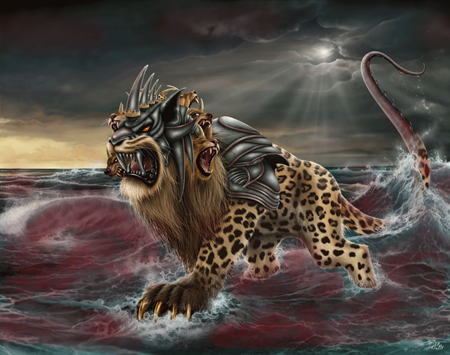
Let’s think and understand deeper the vision again that John saw, he said: The beast I saw resembled a leopard, but had feet like those of a bear and a mouth like that of a lion. The dragon gave the beast his power, his throne, and great authority.”
As I mentioned earlier in the first part and throughout the eight segments on Revelation 12, the religious transformation of the barbarian tribes is significant. Many of these tribes, such as the Goths, Vandals, Franks, and Lombards, eventually adopted Christianity, which played a major role in shaping medieval Europe. Their conversion did not create the Byzantine Empire, nor were they the rulers of it; rather, their Christianization influenced the development of Western Europe and contributed to the rise of new Christian kingdoms.
The Byzantine Empire—heir to the Eastern Roman Empire—did not arise from the barbarian nations, but stood as the direct continuation of Rome after the fall of the Western Empire in 476 AD. Established in the sacred city of Constantinople, it preserved the venerable institutions of Rome and the wisdom of earlier civilizations. Roman law, Hellenic culture, and the enduring light of Eastern Orthodox Christianity shaped its identity. Its governance was marked by a strong central authority and a profound intellectual and spiritual heritage rooted in the Greek tradition.
As the surrounding barbarian tribes gradually adopted the ways of civilization and embraced the Christian faith, their chieftains transformed into monarchs—kings, queens, princes, dukes, and other nobles who would go on to rule the emerging realms of Europe. Yet even as these Christian kingdoms were taking shape, the Byzantine Empire was slowly weakening from within. Internal rivalries, dynastic struggles, and the immense burden of defending an ancient and sprawling empire left it increasingly vulnerable.
Over the centuries, constant military pressure, economic strain, political instability, and the relentless advance of the Ottoman Turks steadily eroded Byzantium’s strength. All these forces ultimately converged in the decisive year 1453, when Constantinople fell to the Ottomans, bringing the long and storied Byzantine Empire to its final end.
I will discuss this in greater detail in my fourth segment.
During these centuries of transformation, the Christian world in the West also underwent profound change. As the political landscape shifted and the old imperial structures weakened, the bishops of Rome gradually emerged as central figures of spiritual authority. The pope—well educated, steeped in Scripture, and entrusted with pastoral leadership—came to be regarded as the head of the Western Church. In the earlier centuries, however, the pope lived within the world of the Byzantine (Eastern) Empire and, like other bishops, was confirmed in his office by the Byzantine emperor. This reflected the ancient unity of the Christian world before the growing separation between East and West.
By the 8th century, the imperial presence in Italy, centered in the Exarchate of Ravenna, was collapsing. The empire, pressed hard by the rise of Islam and preoccupied with defending its eastern frontiers, could no longer protect its Italian territories from the Lombards, who had entered Italy in 568. As imperial influence waned, the bishop of Rome increasingly assumed both spiritual and temporal responsibilities, becoming a stabilizing figure for the Christian communities of the West.
By the 9th century, the title “pope” had become firmly associated with the bishop of Rome, who was acknowledged as the leader of the Roman Catholic Church—the largest of the three major branches of Christianity. In earlier centuries, particularly from the 3rd to the 5th, the title had been applied more broadly to bishops and even to priests, serving as a term of affection and honor among the unified Christian community. Within the Eastern Orthodox tradition, the title continues to be used for the patriarch of Alexandria and for certain Orthodox clergy.
The understanding of the pope as a priest also reflects patterns found in the Old Testament, where God Himself established the priesthood. In Exodus, the Lord commands Moses: “Tell all the skilled workers to whom I have given wisdom in such matters that they are to make garments for Aaron, for his consecration, so he may serve me as priest” (Exodus 28:3). This ancient model of divinely appointed spiritual leadership shaped the early Christian view of sacred office and consecrated ministry.
Doctrinally, within the Roman Catholic tradition, the pope—serving as a priest and the spiritual head of the Church, much as pastors guide many Protestant congregations—is regarded as the successor of St. Peter. Peter, one of the twelve disciples, was appointed by Jesus to shepherd the early Church. Jesus first bestowed upon him a new name, saying, “You are Simon son of John. You will be called Cephas” (which, when translated, is Peter) (John 1:42). Throughout the New Testament, Peter is consistently depicted with images of leadership, authority, and pastoral responsibility among the Apostles.
This calling was further affirmed when Jesus asked His disciples, “Who do people say the Son of Man is?” Peter alone responded, “You are the Messiah, the Son of the living God.” Jesus then declared, “Blessed are you, Simon son of Jonah, for this was not revealed to you by flesh and blood, but by my Father in heaven. And I tell you that you are Peter, and on this rock I will build my church, and the gates of Hades will not overcome it. I will give you the keys of the kingdom of heaven; whatever you bind on earth will be bound in heaven, and whatever you loose on earth will be loosed in heaven” (Matthew 16:18–19).
As bishop of Rome, the pope is therefore understood to possess full and supreme jurisdiction over the universal Church in matters of faith, morals, discipline, and governance. The doctrine of papal primacy rests upon two enduring spiritual foundations: the scriptural role of St. Peter and the historical significance of the Roman Church, long honored as the center of the ancient empire and the sacred site of the martyrdom of both Peter and Paul.
Yet several historians remind us that within the Byzantine world, the pope, despite his spiritual stature, remained, in political terms, a subject of the emperor, and his confirmation, like that of all bishops, required imperial sanction. This dual reality reveals the intricate interplay between heavenly authority and earthly power during the medieval era, a time when Christianity profoundly shaped the course of rising nations and unfolding empires.
As mentioned earlier, the rise of the Ottoman Empire cannot be separated from the emergence of Islam in the 7th century. According to Islamic tradition, a man named Muhammad, born in the Arabian Peninsula and known in his youth as a shepherd and later a merchant, reported receiving revelations from a heavenly messenger. These experiences, which he and his earliest followers believed to be divine in origin, were eventually written down and formed the foundation of the Islamic faith. Many in the region embraced his message, and the new religion spread rapidly across the Middle East.
From a Christian perspective, questions naturally arise regarding the spiritual source of these revelations. When I read portions of Islamic writings shared by a friend, I encountered passages describing an angelic being who claimed great brightness and exalted status. This prompted me to reflect on Scripture, particularly the biblical descriptions of a once-radiant angel who fell from heaven. Revelation 12, along with other passages, invites believers to discern the nature of spiritual influences and to weigh all claims against the testimony of Scripture.
The faith that developed around Muhammad’s teachings eventually shaped the worldview of the Ottoman Turks. Guided by their Islamic beliefs, they expanded their dominion across the Middle East, North Africa, parts of Europe, and regions of Asia. Through their conquests, Islam spread widely across these lands. Yet the rise and fall of earthly empires, whether Byzantine or Ottoman, remains only one strand in the vast and mysterious tapestry of divine providence, in which God’s purposes unfold across the ages.
Thus, the vision granted to John in Revelation 13 does not center on the rise of any single earthly kingdom—such as the Ottoman Empire—but rather on the appearance of a symbolic authority empowered by the adversary. It serves as a solemn reminder that spiritual forces operate beyond the visible movements of nations. The passage calls believers to discernment, steadfastness, and unwavering trust in God’s sovereign rule over history.
As previously explained, John describes the heads and crowns of the beast—ten becoming seven after three had fallen—symbolic imagery that carries deep prophetic meaning. He writes: “The beast I saw resembled a leopard, but had feet like those of a bear and a mouth like that of a lion. The dragon gave the beast his power and his throne and great authority. One of the heads of the beast seemed to have had a fatal wound, but the fatal wound had been healed. The whole world was filled with wonder and followed the beast. People worshiped the dragon because he had given authority to the beast, and they also worshiped the beast and asked, ‘Who is like the beast? Who can wage war against it?’”
This portion of John’s vision is crucial to understand, for certain elements of it have already unfolded in harmony with earlier prophecy. I discussed these developments in my previous writings on Revelation 12, where the visions are shown to be interconnected and mutually illuminating. I encourage you to read them so you may grasp how God reveals His mysteries. In the same way, John’s prophecy in Revelation 13 reaches forward into the future, pointing toward events that continue into the last days—the very age in which we now live. How much of this unfolding each person witnesses depend partly on the length of one’s life and partly on the providential circumstances through which God carries each individual.
Prior to the fall of the Byzantine Empire, another major power was rising in the West—a development many interpret as corresponding to part of the vision in Revelation 13. I will explain the connection between this rapidly emerging empire and the prophecy in a separate segment. The collapse of the Byzantine Empire, followed by the swift expansion of the Ottoman Empire across Byzantium, parts of Europe (such as Bosnia, Serbia, and Spain), the entire Middle East, and much of Asia, is understood—as God revealed it—as part of the symbolic emergence of the beast with multiple heads, ten horns, and ten crowns. The fall of three horns and the rise of the “little horn” from the sea represent the rise of various powers, the overthrow of three barbarian kingdoms, and the transformation of those kingdoms into royal authorities—symbolized by the crowns. I will explain this more fully in the fourth segment.
These elements—the multiple heads, the ten horns, the fallen horns, and the blasphemous little horn—are understood as interconnected symbols representing the rise of various empires. Within this interpretation, the Holy Roman Empire is viewed as a significant part of the composite symbolic beast that emerged from the sea, the very one to whom the dragon granted authority. The rapid rise of the Holy Roman Empire, occurring even as the Byzantine Empire was steadily declining, remains deeply relevant and carries important implications for global events unfolding in these last days.
The Holy Roman Empire began to take firm shape in Western Europe when Charlemagne was crowned emperor by Pope Leo III in 800 AD. Unlike the highly centralized Byzantine Empire, the Holy Roman Empire functioned as a loose and decentralized confederation of territories ruled by kings, princes, and bishops. Its identity was deeply rooted in Roman Catholic tradition and reflected a distinctive blend of Germanic and Latin cultural influences.
Although both the Byzantine Empire and the Holy Roman Empire claimed continuity with ancient Rome and shared a Christian foundation, their paths diverged sharply. The Byzantine Empire represented the Greek-speaking, Orthodox Christian East, while the Holy Roman Empire embodied the Latin-speaking, Catholic Christian West. These differences in language, theology, governance, and culture produced two distinct legacies that profoundly shaped the course of European history.
This has now grown quite extensive. I will continue with the 4th segment next.