
All Topics
Messages

- Details
- Written by: Messenger
- Category: Messages
As we’ve seen throughout the Gospels, Jesus traveled from city to city fulfilling His divine mission — preaching the good news, calling people to repentance, healing the sick, and performing miracles. Often, when people came to Him in faith, Jesus didn’t need to touch them. He simply spoke, saying, “Your faith has healed you.” That’s the power of God — miracles released through faith alone. When we pray with sincere belief, God’s power moves, even without physical contact. That’s how miracles happen.
Yet, there were moments when Jesus chose to heal in a different, more symbolic way. One such moment was the healing of a deaf-mute man — a story that invites deeper reflection.
Jesus had just left the region of Tyre and passed through Sidon, heading toward the Sea of Galilee and into the region of the Decapolis. There, some people brought to Him a man who was deaf and could barely speak. They begged Jesus to lay His hand on him.
Here’s what happened next:
Jesus took the man aside, away from the crowd. He put His fingers into the man’s ears. Then He spit and touched the man’s tongue. He looked up to heaven, and with a deep sigh said, “Ephphatha!” (which means “Be opened!”)
At that moment, the man’s ears were opened, his tongue was loosened, and he began to speak clearly. Jesus commanded them not to tell anyone, but the more He did, the more they spread the news. People were overwhelmed with amazement and said, “He has done everything well. He even makes the deaf hear and the mute speak!” (Mark 7:31–37)
Why did Jesus choose this method — touching the man’s ears and tongue — instead of simply speaking healing into existence, as He had done before?
The answer lies in the heart. God sees not only our physical condition but also the state of our soul. He knows what we hear, what we say, and what we think. In this man’s case, Jesus may have seen a deeper need — not just for physical healing, but for spiritual cleansing.
Perhaps this man had grown up in an environment filled with gossip, profanity, or harmful speech. Jesus’ actions — touching the ears and tongue — were symbolic. They represented a purification of what the man would hear and speak going forward. It was a divine act of renewal, not just of the body, but of the heart and mind.
This healing reminds us of the words of the prophet Isaiah:
“Yet you, Lord, are our Father. We are the clay, you are the potter; we are all the work of your hand.” (Isaiah 64:8)
Jesus, the divine Potter, was reshaping this man — not just restoring his senses, but remolding his life. The man couldn’t speak for himself, but Jesus saw his faith. And in front of the crowd, Jesus demonstrated that healing is not only about restoring what is broken, but also about transforming what is impure.
We, too, are clay in the hands of the Potter. Sometimes, healing requires more than a word — it requires a touch that reaches deep into our soul.

- Details
- Written by: Messenger
- Category: Messages
From the sacred writings and visions passed down by God’s chosen people, we learn that Jesus journeyed across Israel—walking from city to city, town to town, and village to village. He traveled on foot, without a horse, accompanied by His twelve disciples. At times, other followers joined Him, including devoted women who supported His ministry and helped gather donations from those moved by His message. But most often, it was just Jesus and the twelve.
Remarkably, Jesus didn’t limit His travels to Israel alone. He walked as far as Lebanon and Syria, reaching places like Tyre and Sidon—regions where Jewish communities had settled. Who would have imagined that Jesus ventured so far? Yet the records confirm it.
Jesus’ ministry wasn’t only about preaching and feeding the multitudes. A significant part of His mission was healing the sick—those who came to Him in desperation, begging for mercy. But there were also moments when Jesus healed someone without being asked, simply because He saw their pain and knew their heart.
One such moment was the healing of a man with a shriveled hand. In today’s terms, we might call it a congenital deformity or a lifelong disability. The man didn’t cry out for help. He didn’t plead for healing. But Jesus, in His divine wisdom, saw him and chose to act.
Why? Because Jesus knows the hearts of men. He doesn’t need to be asked to show compassion. He moves with purpose, guided by love and truth. His miracles are never random—they are intentional, revealing the mercy and power of God.
Here is the story of that man…
Another time, Jesus went into the synagogue, and a man with a shriveled hand was there. Some of them were looking for a reason to accuse Jesus, so they watched Him closely to see if He would heal him on the Sabbath. Jesus said to the man with the shriveled hand,
“Stand up in front of everyone.”
Then Jesus asked them,
“Which is lawful on the Sabbath: to do good or to do evil, to save life or to kill?”
But they remained silent.
Jesus looked around at them in anger and, deeply distressed at their stubborn hearts, said to the man,
“Stretch out your hand.”
He stretched it out, and his hand was completely restored.
Then the Pharisees went out and began to plot with the Herodians how they might kill Jesus.
The healing of the man with the shriveled hand ignited even greater fury among the Jewish Pharisees. This moment stands out as one of the most revealing in Jesus’ ministry. The Pharisees were constantly watching Him—scrutinizing His every word and action. They witnessed His miracles, His healings, and the undeniable power of God flowing through Him. Yet, despite seeing these wonders with their own eyes, they remained trapped in unbelief.
Their anger boiled over when they accused Jesus of violating the Sabbath. But Jesus reminded them of a deeper truth: God is still the Lord of the Sabbath. Though the full meaning of the Sabbath deserves its own discussion, Jesus offered a simple yet profound example:
“If one of you has a sheep and it falls into a pit on the Sabbath, won’t you lift it out?” In other words, doing good, even on the Sabbath, is not only lawful, it is righteous.
The Pharisees’ outrage wasn’t just about rules. Deep down, they were angry because they saw the truth in Jesus—and they rejected it. Their hardened hearts, shaped by pride and sin, blinded them to the very power of God in their midst.
This kind of spiritual blindness still exists today. Many people respond to goodness not with gratitude, but with resentment. They twist the truth, calling what is holy “evil” and what is evil “good.” This isn’t just rejection—it is blasphemy against the Holy God, the Trinity.
Because of such hardened unbelief, hell was prepared—not for humanity, but for Satan and his fallen angels. Yet those who stubbornly reject God’s mercy and truth choose that path for themselves. Hell is not God’s desire for anyone, but it becomes the final judgment for those who refuse to repent.
To the faithful: take heart. Be patient. Do not lose your grip on faith. The return of Jesus is certain. While you wait, guard your heart against deception. Don’t be discouraged by trials or distracted by the world. Stand firm. Hold fast to the truth. Your endurance will not be in vain.
- Details
- Written by: Messenger
- Category: Messages
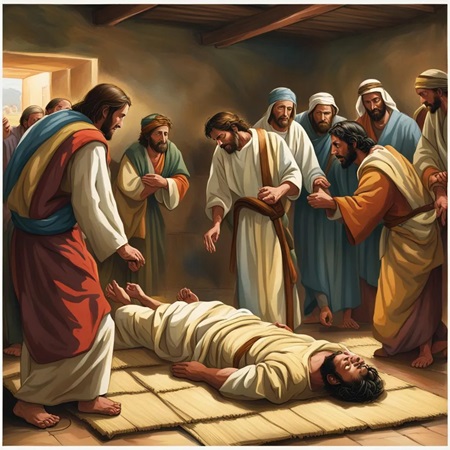
A few days later, when Jesus again entered Capernaum, the people heard that He had come home. They gathered in such large numbers that there was no room left, not even outside the door, and He preached the word to them. Some men came, bringing to Him a paralyzed man, carried by four of them. Since they could not get him to Jesus because of the crowd, they made an opening in the roof above Jesus by digging through it and then lowered the mat the man was lying on.
When Jesus saw their faith, He said to the paralyzed man,
“Son, your sins are forgiven.”
Now some teachers of the law were sitting there, thinking to themselves,
“Why does this fellow talk like that? He’s blaspheming! Who can forgive sins but God alone?”
Immediately Jesus knew in His spirit that this was what they were thinking in their hearts, and He said to them,
“Why are you thinking these things?” Which is easier: to say to this paralyzed man, ‘Your sins are forgiven,’ or to say, ‘Get up take your mat and walk?’ But I want you to know that the Son of Man has authority on earth to forgive sins.”
So, He said to the man,
“I tell you, get up, take your mat, and go home.”
He got up, took his mat, and walked out in full view of them all. This amazed everyone and they praised God, saying,
“We have never seen anything like this!”