
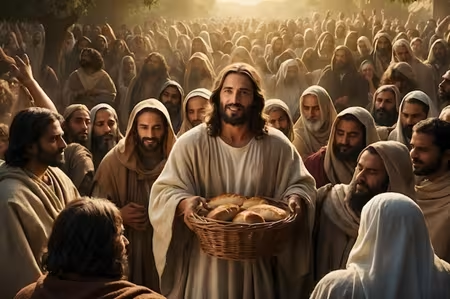
Not everyone who responds to the gospel does so with genuine faith and repentance. Some are drawn to Christianity by motives other than a sincere desire to know and obey God. Throughout history, there have been those who identified with the Christian faith for personal advantage—whether social acceptance, material benefit, security, or financial gain. While outwardly they may appear committed, God alone knows the true condition of every heart.
The ministry of Jesus reveals this reality. On one occasion, large crowds eagerly sought Him, but many were not motivated by a genuine hunger for God's truth or a desire for repentance. Instead, they followed Him because they had received material benefits and hoped for more. Their outward enthusiasm concealed hearts that were not truly seeking the kingdom of God. The following account illustrates this important lesson.
When they found him on the other side of the lake, they asked him, “Rabbi, when did you get here?”
Jesus answered, “Very truly I tell you, you are looking for me, not because you saw the signs I performed but because you ate the loaves and had your fill. Do not work for food that spoils, but for food that endures to eternal life, which the Son of Man will give you. For on him God the Father has placed his seal of approval.”
Then they asked him, “What must we do to do the works God requires?”
Jesus answered, “The work of God is this: to believe in the one he has sent.”
So they asked him, “What sign then will you give that we may see it and believe you? What will you do? Our ancestors ate the manna in the wilderness; as it is written: ‘He gave them bread from heaven to eat.’”
Jesus said to them, “Very truly I tell you, it is not Moses who has given you the bread from heaven, but it is my Father who gives you the true bread from heaven. For the bread of God is the bread that comes down from heaven and gives life to the world.”
“Sir,” they said, “always give us this bread.”
Then Jesus declared, “I am the bread of life. Whoever comes to me will never go hungry, and whoever believes in me will never be thirsty. But as I told you, you have seen me and still you do not believe. All those the Father gives me will come to me, and whoever comes to me I will never drive away. For I have come down from heaven not to do my will but to do the will of him who sent me. And this is the will of him who sent me, that I shall lose none of all those he has given me, but raise them up at the last day. For my Father’s will is that everyone who looks to the Son and believes in him shall have eternal life, and I will raise them up at the last day.”
At this the Jews there began to grumble about him because he said, “I am the bread that came down from heaven.” They said, “Is this not Jesus, the son of Joseph, whose father and mother we know? How can he now say, ‘I came down from heaven’?”
“Stop grumbling among yourselves,” Jesus answered. “No one can come to me unless the Father who sent me draws them, and I will raise them up at the last day. It is written in the Prophets: ‘They will all be taught by God.’[Everyone who has heard the Father and learned from him comes to me. No one has seen the Father except the one who is from God; only he has seen the Father. Very truly I tell you, the one who believes has eternal life. I am the bread of life. Your ancestors ate the manna in the wilderness, yet they died. But here is the bread that comes down from heaven, which anyone may eat and not die. I am the living bread that came down from heaven. Whoever eats this bread will live forever. This bread is my flesh, which I will give for the life of the world.”
Then the Jews began to argue sharply among themselves, “How can this man give us his flesh to eat?”
Jesus said to them, “Very truly I tell you, unless you eat the flesh of the Son of Man and drink his blood, you have no life in you. Whoever eats my flesh and drinks my blood has eternal life, and I will raise them up at the last day. For my flesh is real food and my blood is real drink. Whoever eats my flesh and drinks my blood remains in me, and I in them. Just as the living Father sent me and I live because of the Father, so the one who feeds on me will live because of me. This is the bread that came down from heaven. Your ancestors ate manna and died, but whoever feeds on this bread will live forever.” He said this while teaching in the synagogue in Capernaum.
On hearing it, many of his disciples said, “This is a hard teaching. Who can accept it?”
Aware that his disciples were grumbling about this, Jesus said to them, “Does this offend you? Then what if you see the Son of Man ascend to where he was before! The Spirit gives life; the flesh counts for nothing. The words I have spoken to you—they are full of the Spirit and life. Yet some of you do not believe.” For Jesus had known from the beginning which of them did not believe and who would betray him. He went on to say, “This is why I told you that no one can come to me unless the Father has enabled them.”
From this time, many of his disciples turned back and no longer followed him.
“You do not want to leave too, do you?” Jesus asked the Twelve.
Simon Peter answered him, “Lord, to whom shall we go? You have the words of eternal life. We have come to believe and to know that you are the Holy One of God.”
Then Jesus replied, “Have I not chosen you, the Twelve? Yet one of you is a devil!” (He meant Judas, the son of Simon Iscariot, who, though one of the Twelve, was later to betray him.)
Jesus foresaw that many would turn away from the faith when confronted with trials, persecution, and suffering. Throughout Scripture, God permits His people to undergo testing—not to weaken or destroy their faith, but to reveal its authenticity, strengthen their character, and deepen their dependence upon Him. No believer is exempt from this process. Every follower of Christ will encounter circumstances that test faith, obedience, perseverance, and unwavering trust in God's promises.
The lives of God's faithful servants illustrate this enduring principle. Abraham's faith was tested when God commanded him to offer Isaac, yet he obeyed in confidence that God would fulfill His promises. Isaac and Jacob likewise endured seasons of hardship that refined their faith and taught them to rely upon God's covenant faithfulness. Their lives demonstrate that genuine faith is not merely professed with words but proven through steadfast obedience, patient endurance, and unwavering trust in God.
Jesus repeatedly warned His disciples that following Him would require sacrifice. He never promised an easy or comfortable life; instead, He called His followers to wholehearted commitment, even in the face of suffering. He declared:
"If anyone would come after me, let him deny himself and take up his cross and follow me. For whoever wants to save his life will lose it, but whoever loses his life for my sake will find it. For what will it profit a man if he gains the whole world and forfeits his soul? Or what shall a man give in return for his soul?" (Matthew 16:24–26)
These words remind believers that the cost of discipleship is real, but so is its eternal reward. The temporary hardships, sacrifices, and persecutions endured for Christ cannot be compared with the glory that God has promised to those who remain faithful. The sufferings of this present life are brief, but the inheritance awaiting God's people is everlasting—eternal life in His presence, where death, sorrow, pain, and decay will exist no more.
No earthly possession, achievement, or human promise can compare with what God offers through Jesus Christ. He alone promises forgiveness of sins, the resurrection of the dead, eternal life, and an imperishable inheritance in His everlasting kingdom. These promises provide believers with the strength to endure present trials, knowing that every sacrifice made for Christ will be rewarded by the One who is faithful to all His promises.