All Topics
Messages

- Details
- Written by: Messenger
- Category: Messages
The division between the Roman Catholic Church and the Protestants traces its roots to the Reformation of the 16th century, sparked by the teachings of the German reformer Martin Luther. This movement unfolded long after the collapse of the Western Roman Empire, which had been defeated by barbarian groups such as the Heruli and Visigoths. Following Rome’s fall, tribes like the Ostrogoths (who merged with the Heruli), Vandals, and Huns diminished and eventually assimilated into the broader barbarian populations of Europe.
Symbolically, this merging is reflected in John’s vision of the dragon: three heads cut off, leaving seven. The seven crowns represent the rise of ten barbarian kings, later reduced to seven. Over time, these tribes absorbed elements of Roman and Greek culture, adopting arts, governance, and civility. As they became more receptive to truth, their leaders and tribes converted to Christianity.
The conversion of Constantine I marked a turning point, bringing a temporary pause in Christian persecution. This moment partly fulfilled John’s vision: “The woman was given the two wings of a great eagle, so that she might fly to the place prepared for her in the wilderness, where she would be taken care of for a time, times and half a time, out of the serpent’s reach.” Christianity became the foundation of Europe, transforming former barbarian tribes into nations.
In John’s vision, the dragon bore ten crowns, symbolizing the royalty of the ten major barbarian tribes—the ten heads of the dragon, as recorded in Revelation 13. The eagle’s wings, described in Revelation 12, represent the swiftness with which Christianity spread, first across Europe and later to the Americas. These two wings, given to the woman (the Church), symbolize the power of Christianity in shaping both continents.
It was not only the twelve disciples who believed in Jesus and followed Him; other Jews also embraced the faith and carried the truth beyond Israel, fleeing persecution. Tradition holds that all twelve disciples, except John—the author of the Book of Revelation—did not die but ascended to heaven after completing their mission. Christian Jews, together with converted non-Jews, spread the message widely, ensuring the growth of the faith across nations.
The significance of these visions extends further, and I will explore their connection to the birth of the United States in a separate discussion.
Revelation 13 continues this imagery: “The dragon stood on the shore of the sea. And I saw a beast coming out of the sea. It had ten horns and seven heads, with ten crowns on its horns, and on each head a blasphemous name.” The dragon, revealed as Satan, stood among the masses, awaiting events to unfold. The beast with ten horns and seven heads reflects the barbarian tribes already identified. The crowns and blasphemous names carry deeper meaning, which I will unravel in detail later, as they hold significance for the eventual birth of the USA.
As Christianity spread, not all believers accepted the full truth of the apostles’ teachings. Distortions arose, fueled by Satan’s influence through false teachers. This division led to the emergence of Arian Christians and later Nicene Christians. Around 318 CE, Arius, a priest in Alexandria, argued that Christ was a created being, not eternal, and therefore not God. His teaching echoed Judaism’s rejection of Jesus’ divinity, the same belief that led the Pharisees and Sadducees to demand His crucifixion under Pilate.
Arianism spread quickly but was opposed by Bishop Alexander of Alexandria and Athanasius, who defended Christ’s eternal nature and unity with God the Father. This controversy marked a critical stage in Christianity’s early development. To resolve it, the Roman Catholic Church convened the Council of Nicaea in 325 AD. The council produced the Nicene Creed, affirming Jesus’ divinity and unifying the Church. This creed provided Christianity with a common theological foundation and a framework for resolving disputes, securing the faith during its formative years.
Christianity began with a shared theological foundation and a system for resolving disputes, which helped preserve the faith during its early formative years. Although historians rarely state it openly, the divisions within Christianity were deeply tied to the struggle for control as the faith developed into an organized religion under the Roman Catholic Church, which at that time functioned as a single unified institution. Questions of authority, leadership, and who held the right to guide the new religion fueled these conflicts. As the seven barbarian tribes converted and became more civilized, their rulers rose to power as influential monarchies—an outcome many interpret as the fulfillment of John’s vision in which ten became seven after three were removed.
Before turning to the vision in Revelation 13, it is essential to recall the powerful proclamation in Revelation 12. John describes hearing a loud voice in heaven declaring: “Now have come the salvation and the power and the kingdom of our God, and the authority of his Messiah. For the accuser of our brothers and sisters, who accuses them before our God day and night, has been hurled down. They triumphed over him by the blood of the Lamb and by the word of their testimony; they did not love their lives so much as to shrink from death. Therefore rejoice, you heavens and you who dwell in them! But woe to the earth and the sea, because the devil has gone down to you! He is filled with fury, because he knows that his time is short.”
This heavenly announcement reflects God’s plan of salvation following the rebellion in heaven, when Satan and the one‑third of angels who accepted his deception were cast into the abyss. (I discuss the nature of the abyss in another section.) After their defeat in that first heavenly conflict, Satan and his angels were confined to this abyss. It was then that God chose to descend into this place of darkness and formlessness and create the universe—a creation Satan later falsely claimed as his own. This world, once void and without form, was part of that abyss. But when God spoke the words “Let there be light,” He revealed His unmatched creative power before the fallen angels.
Bound in darkness for ages—perhaps for spans of time beyond human comprehension—Satan and his angels were given the opportunity to create something of their own. Yet across all those ages, they produced nothing. Their inability to create anything demonstrates a fundamental truth: the power to create belongs to God alone.
Read the next part….

- Details
- Written by: Messenger
- Category: Messages
Satan is utterly shameless. He even dared to appear before Jesus and attempt to tempt Him. His pride and rebellion were revealed most clearly when he confronted the Lord after His forty days of fasting. As Matthew records:
“Then Jesus was led by the Spirit into the wilderness to be tempted by the devil. After fasting forty days and forty nights, he was hungry. The tempter came to him and said, ‘If you are the Son of God, tell these stones to become bread.’
Jesus answered, ‘It is written: Man shall not live on bread alone, but on every word that comes from the mouth of God.’
Then the devil took him to the holy city and had him stand on the highest point of the temple. ‘If you are the Son of God,’ he said, ‘throw yourself down. For it is written: He will command his angels concerning you, and they will lift you up in their hands, so that you will not strike your foot against a stone.’
Jesus answered him, ‘It is also written: Do not put the Lord your God to the test.’
Again, the devil took him to a very high mountain and showed him all the kingdoms of the world and their splendor. ‘All this I will give you,’ he said, ‘if you will bow down and worship me.’
Jesus said to him, ‘Away from me, Satan! For it is written: Worship the Lord your God, and serve him only.’
Then the devil left him, and angels came and attended him.” (Matthew 4:1–11)
This event, which Jesus surely shared with His disciples, shows us that Satan is shameless. He dared to confront the Son of God with pride, mocking Him as if He were merely human, believing he could win over God through temptation. But Jesus, God in human flesh, demonstrated that even in weakness, temptation can be overcome.
Lessons from the Temptations
1. The Temptation of Bread
Bread symbolizes human needs, often tied to finances. Satan tempts people to lie, cheat, or steal to satisfy hunger or sustain a lifestyle. But Jesus taught that true life comes not from bread or money, but from God’s Word. We must pray and depend on Him, knowing that trials test our faith. God blesses His people, not to make them lazy or indulgent, but to equip them to bless others. Wealth is meant to be used as an instrument of charity, not selfishness.
2. The Temptation of Presumptive Faith
Satan tempted Jesus to throw Himself from the temple, twisting Scripture to suggest that angels would surely protect Him. But Jesus revealed that genuine faith is never reckless presumption. We must not deliberately place ourselves in danger and then expect God to intervene. Such presumptive faith dishonors God, for as Paul wrote, “God cannot be mocked.” True faith trusts God without putting Him to the test.
For example, imagine jumping into a lake without knowing whether it is safe to swim, or swallowing a pill at the urging of a taunting friend even though you know it could harm your health. To reason, “God is with me, so nothing will happen,” is not faith—it is folly. Authentic trust in God never excuses careless or dangerous choices.
3. The Temptation of Power and Worship
Satan shamelessly asked Jesus to worship him in exchange for worldly kingdoms. This reveals his arrogance in demanding honor from the very Creator who made him. It also warns us that Satan tempts through pride, luxury, popularity, and the pursuit of lavish living. Jesus, however, lived humbly as a carpenter, reminding us that greatness in God’s kingdom is found in humility and obedience.
Faith Tested Like Abraham and the Disciples
God has always tested His people. Abraham was asked to sacrifice his only son, Isaac, and he obeyed. He remained faithful, avoiding sin and adultery, living uprightly before God. Likewise, the disciples endured bitter trials. All except John died by sword or crucifixion, proving that no follower of Christ is exempt from testing. God alone decides whom He favors, for He knows the hearts and minds of all.
The Reality of Spiritual Warfare
Satan also works through possession and temptation. In Jesus’ time, many were possessed by evil spirits, and He cast them out. Today, Satan lures people through vices such as gambling, addictions, laziness, or even obsession with worldly pleasures. These are avenues of worship to him. But Jesus gave us the weapon of His Word: “Go away, Satan! You are an offense to my God.”
- Details
- Written by: Messenger
- Category: Messages
As I explained in Part Five on John’s vision in Revelation 12, no one can truly understand the mysteries of God without His guidance. God alone reveals His truth to those He anoints, and only His chosen messengers can faithfully declare it. Those who claim to be prophets yet sell the truth for gain are the very false prophets Jesus warned against.
Jesus said:
“Watch out for false prophets. They come to you in sheep’s clothing, but inwardly they are ferocious wolves. By their fruit you will recognize them. Do people pick grapes from thornbushes, or figs from thistles? Likewise, every good tree bears good fruit, but a bad tree bears bad fruit. A good tree cannot bear bad fruit, and a bad tree cannot bear good fruit. Every tree that does not bear good fruit is cut down and thrown into the fire. Thus, by their fruit you will recognize them.” (Matthew 7:15–20)
True prophets and disciples never worked for money; they lived by God’s mercy, sustained by the generosity of those whose hearts He touched. They did not ask for payment, but gave their lives as defenders and heralds of truth, assured of eternal life as their reward.
One powerful example of this principle is found in the story of Naaman, the Syrian commander who suffered from leprosy. Seeking healing, he went to the prophet Elisha. Elisha instructed him to wash in the Jordan River seven times. At first, Naaman hesitated, offended by the simplicity of the command and the thought of bathing in what he considered a dirty river. Yet, after his soldiers urged him to obey, he humbled himself and followed the prophet’s words. On the seventh immersion, Naaman rose from the water completely healed, his leprosy gone.
Overwhelmed with gratitude, Naaman returned to Elisha with his attendants, bringing large amounts of gold and silver as payment. Standing before the prophet, he declared, “Now I know that there is no God in all the world except in Israel. So please accept a gift from your servant.” But Elisha replied firmly, “As surely as the Lord lives, whom I serve, I will not accept a thing.” Though Naaman urged him, Elisha refused.
This account demonstrates that true prophets of God do not sell His truth or accept payment for His miracles. They serve freely, sustained only by God’s mercy, and their reward is not earthly wealth but the assurance of eternal life.
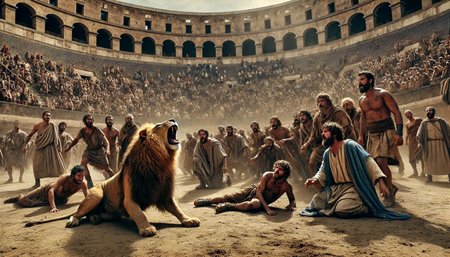
God chose John as the last disciple to record what would happen after the apostles were gone. Revelation 12 is filled with visions and meanings that only God Himself knows, and John was simply instructed to write them down. One of its central messages is the prophecy of the 1,260 years of persecution—a long era when faithful Christians endured suffering for their devotion to God. Many abandoned the faith out of fear of fire, lions, the sword, or beheading, while others remained steadfast, even unto death, against the cruelty of Satan’s agents.
As history unfolded, some Christians who assumed leadership aligned themselves with Constantine I, known as Constantine the Great. Under his reign, pagan practices from Rome were gradually integrated into the church’s faith. This compromise sparked deep disagreement among believers. Those who remained faithful to God’s truth rejected the blending of Christianity with paganism, and their resistance gave rise to a great division within the church. Over time, this division grew stronger and more visible, as courageous believers openly spoke against corruption and false teachings. Their stand marked the beginning of the divide that would later shape the history of Christianity into Roman Catholicism and Protestantism.
"I encourage you to turn to Part Seven of this vision and its revelation on its own, for the message grows expansive and profound. To remain in the same place may cloud understanding, but in its own space the truth shines more clearly."